Showing posts with label snacks. Show all posts

Thursday, July 6, 2017

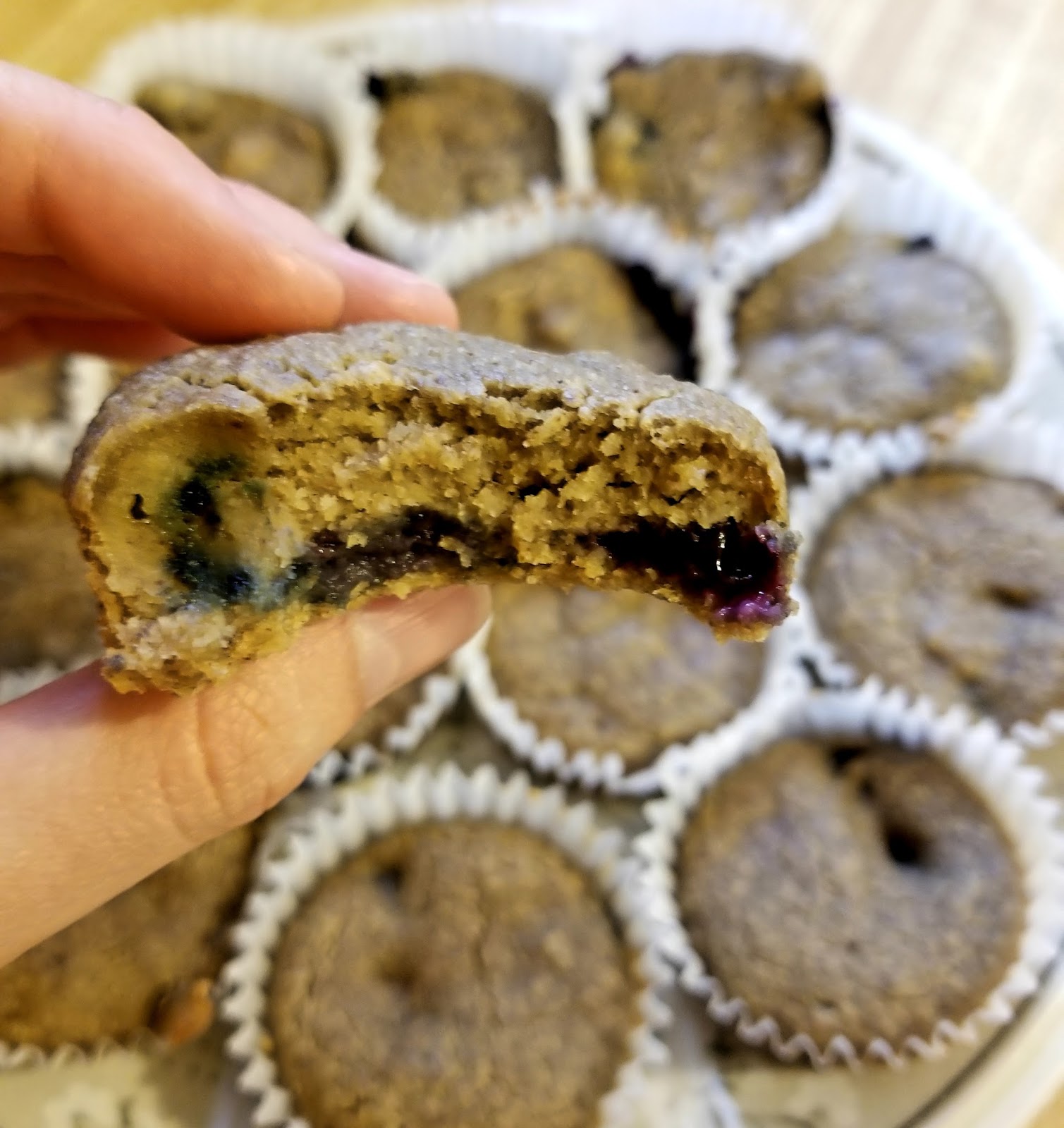
Lemon-Berry Muffins

Recently, I have been looking for a better-for-you muffin recipe that I could make and have as a snack when I wanted something sweet. A lot of the gluten-free, vegan baked goods are loaded with sugar and have really little fiber. I ended up combining a few of the recipes in my cookbooks with others I found online for these sweet little treats! I love making them in mini-muffin pans; however, for the recipe below, I used a standard 12-count muffin tray. Enjoy!

Lemon-Berry Muffins 
*Vegan + Gluten-Free 

Ingredients
1 large banana
1/2 cup almond milk
2 tablespoons almond butter
1.5 teaspoons lemon juice
1 teaspoon vanilla extract
1 1/4 cup gluten-free rolled oats (uncooked)
1/2 cup almond flour
1/4 cup 100% pure maple syrup
1/2 teaspoon baking soda
Pinch salt
1/2 cup blueberries

Directions
1. Preheat oven to 350 degrees F. Grease a 12-count muffin tray or line with muffin cups.
2. Add all ingredients, except blueberries to a blender and blend until smooth. Mixture will be thick; however, if there are issues blending, add in almond milk, 1 tablespoon at a time.
3. Fold in blueberries. Spoon mixture into prepared tray and bake for 15-20 minutes.

Recipe Notes
-Makes 12 standard-sized muffins, serving 6.
-Can make in a mini-muffin tray; however, decrease cooking time to about half.
-Can substitute cashew milk or pea milk for almond. Pea milk will add in protein.
-Can substitute sunflower seed butter or peanut butter for the almond.
-If you are not gluten-free, can use regular rolled oats
-Store at room temperature for 2-3 days in an air-tight container or in the fridge up to 1 week.

Thursday, June 22, 2017

Pizza Quinoa Bites

Welcome back to PorrazzaNutrition! Today, I want to share with you a recipe I just revamped from my old cooking files. I have been trying to weed through my collection of recipes to figure out the ones I actually use and those I was just hoarding :) I am challenging myself to 1 day per week where I try new recipes and incorporate the tasty ones into my weekly meals or party rotation (since I usually bring healthy dishes wherever I go). My challenge to you this month is to get in the kitchen and try a new recipe or revamp (in a healthy way) an old one from your collection!

Pizza Quinoa Bites

Ingredients
1 cup uncooked quinoa
1/2 cup low salt tomato sauce **
1.5 cups water
1 small onion, diced
1 teaspoon olive oil
2 teaspoons minced garlic
2 flax eggs **
1/2 cup fresh basil, chopped
1/2 cup grape tomatoes, diced
1 teaspoon Italian seasoning
1/2 cup nutritional yeast **
Dash of salt and pepper

Directions
1. In a large pot, bring to a boil quinoa, tomato sauce, and water. Lower and simmer, covered, for 20 minutes.
2. Preheat oven to 350 degrees F and line a baking sheet with parchment paper.
3. In a small saucepan, saute onion and garlic in olive oil for 3-5 minutes over medium-low heat.
4. In a large bowl, mix together onion/garlic, quinoa, flax eggs, basil, tomatoes, Italian seasoning, nutritional yeast, salt and pepper. Adjust seasonings to your taste.
5. Form mixture into bite-sized patties and place on prepared baking sheet. Bake for 15-20 minutes. Flip and bake for an additional 5 minutes (or broil for 1-2 minutes for crispier patties). Serve with fresh tomato sauce.

**Recipe Notes
-No-salt-added crushed tomatoes can be used in place of tomato sauce.
-To make a single flax egg, which is a replacement for 1 whole egg, simply mix 1 tablespoon of ground flaxseeds with 3 tablespoons of water. Double to make the two needed for this recipe.
-Nutritional yeast is a substitute for dairy-cheeses and can be found online or at most health-food stores.

Thursday, June 8, 2017

Simple Homemade Applesauce

This past week, I shared my super simple, no-added-sugar, recipe for homemade applesauce with my cooking class. This is one of my favorite recipes to make especially when I have some older and softer apples. I love the way my house smells while this is cooking too :)

When choosing apples, look for ones with a shiny, firm, and smooth skin. Apples are a good source of vitamin C, which boosts your immune health, and a great source of fiber, which is good for digestive health and may help to lower cholesterol levels. Apples are also high in antioxidants, which may help to reduce your risk of cancer, hypertension, diabetes, and heart disease. It is best to leave the skin on your apples to retain all of the fiber and nutrients. With the recipe below, since you will be blending the final product, you won't even notice the skins!

Homemade Applesauce (Stove-top)*
Yield: approx. 4 cups

Ingredients
4 apples, roughly chopped, with skins
1/2 cup water
1 teaspoon cinnamon
Pinch ground nutmeg

Directions
1. In a large saucepan, mix together all ingredients. Cover and cook on medium heat for about 15-20 minutes or until softened.
2. Using an immersion blender, blend apples to reach desired consistency.**
3. Store in an air-tight container in the fridge (I used mason jars).

Notes
*Recipe can be made in a slow-cooker. Cook on low for 3-4 hours (will vary based on size of slow-cooker and amount of apples).
**You can also use a fork or standing blender to mash/puree the apples to your desired consistency. 

Nutrition Per 1 Cup: 70 Calories, 150mg Potassium, 19g Carbohydrates, 3g Fiber, 14g Sugar, 13% DV for Vitamin C

Tuesday, March 8, 2016

Conventional Vs. Organic Produce

One of the debates going on now is whether or not organic produce is more nutritious than conventional produce.

As per the USDA, "Produce can be called organic if it's certified to have grown on soil that had no prohibited substances applied for 3 years prior to harvest. Prohibited substances include more synthetic fertilizers and pesticides.""Synthetic fertilizers, sewage sludge, irradiation, and genetic engineering may not be used." Organic farms and processors support animal health and welfare, do not use genetically modified ingredients, separate organic food from non-organic, and preserve natural resources.

There are some minimal differences in the nutritional profile between organic and conventional produce with organic being higher. This difference, however, is not substantial enough to fully say that all organic is better than conventional. There is some alarm being raised with the pesticide use on conventional produce. Pesticides are regulated by the EPA and are mainly used to protect the produce from bugs and extend their shelf life. There has been some links in research from exposure to pesticides to cancers and brain/central nervous system defects.

Before you start throwing away everything in your fridge, know that there is a threshold for the amount of pesticides you can consume safely. Also, different fruits and vegetables have varying levels of pesticide residues. I love the Safe Fruits and Veggies pesticide calculator because you can see how much of the item you would need to eat in order to see any negative effects from the pesticides. For example, a woman would need to consume more than 2332 servings of kale in one day to have any sort of effect of the pesticides even if the kale had the highest levels of residues. For women and potato consumption, the amount is more than 7379 servings in one day to see any harmful effects.

Check out the link below for a complete list of the dirty dozen (produce with the highest level of pesticide residue that are best to buy organic) and clean fifteen (produce with the lowest level of pesticide residue).
-->Dirty Dozen (best to buy organic) --> LINK
--> Clean 15 and Dirty Dozen Cards --> LINK

One of the biggest complaints about buying organic is that it is more expensive than the conventional. While this may be true, think about how much of the produce you consume that is on the dirty dozen list and if you could spend a little bit more money in this area than in other areas (like on snacks or treats). I don't want those of you reading this to think that if you can't afford organic, that means you should avoid fruits and vegetables. That is certainly not the case! Fruits and vegetables can reduce the risk of so many diseases. Also, it is way better to eat a conventionally grown apple than it is to eat potato chips or donuts.

One way to keep your produce safe is to make sure it is washed thoroughly. For conventional or organic produce, the FDA recommends washing fruits and vegetables under running water just before eating or cooking, using a brush to scrub produce with hard surfaces, and cutting away any damaged or bruised areas. If you buy lettuce or greens in a bundle, the recommendation is to toss the outer layer. By following these steps, you can decrease, if not eliminate, the pesticide residue on your produce.

Below are some other great links I discovered for pesticides and safety levels along with organic practices and standards!

Risk Level Calculator --> LINK
Research on Pesticide Residues --> LINK
Organic Standards USDA --> LINK
Introduction to Organic Practices --> LINK

Eating fruits and vegetables (conventional or organic) is way better than eating the processed junk foods. Finally, organic chips and pretzels are still just chips and pretzels. So, don't be blinded by the use of the word organic for covering up junk!



Sunday, February 1, 2015

Chocolate Dipped Oranges

Part of my job as a Retail Dietitian is doing healthy food demonstrations. In one of my recent demos, I highlighted oranges; mainly because of cold and flu season (Vitamin C) and they were on sale.  It was so funny doing this demo because I got a ton of people saying either, "This is healthy?" or "I never thought to combine chocolate and oranges."  Most people have the impression that healthy eating is bland or boring. Then when you present these people with healthy recipes that taste good, they are in shock! The way you prepare food and how good it tastes is completely subjective. Get creative in the kitchen and try new recipes and spices to spruce up your meals! While you are at it, try my chocolate dipped oranges for a sweet snack:)

How to Select/Store Oranges
Select an orange that is firm, shiny, and heavy for its size. The fruit should be free of any soft spots or wrinkles. Oranges should be kept in a cool, well-ventilated area. You can store in the fridge for 2 weeks or at room temperature for 4 days.


My Chocolate Dipped Oranges :)
Chocolate Dipped Oranges
Ingredients
2-4 ounces of dark chocolate
1 medium orange, peeled and segmented

Directions
1. Line a baking sheet with wax or parchment paper.
2. Melt chocolate (microwave or double broiler). Dip orange segments in chocolate and transfer to baking sheet. Set aside until chocolate hardens. Serve at room temperature.

**I found it easier to only dip 1/2 of one side of the orange. This way I didn't lose any chocolate when I removed the oranges for serving. You can also use clementines instead!

For about 1/2 the orange with chocolate, your looking at about 180 calories. Not too shabby for a sweet treat. Not to mention the 75% of your daily value of Vitamin C :)


http://recipes.sparkpeople.com/recipe-calculator.asp